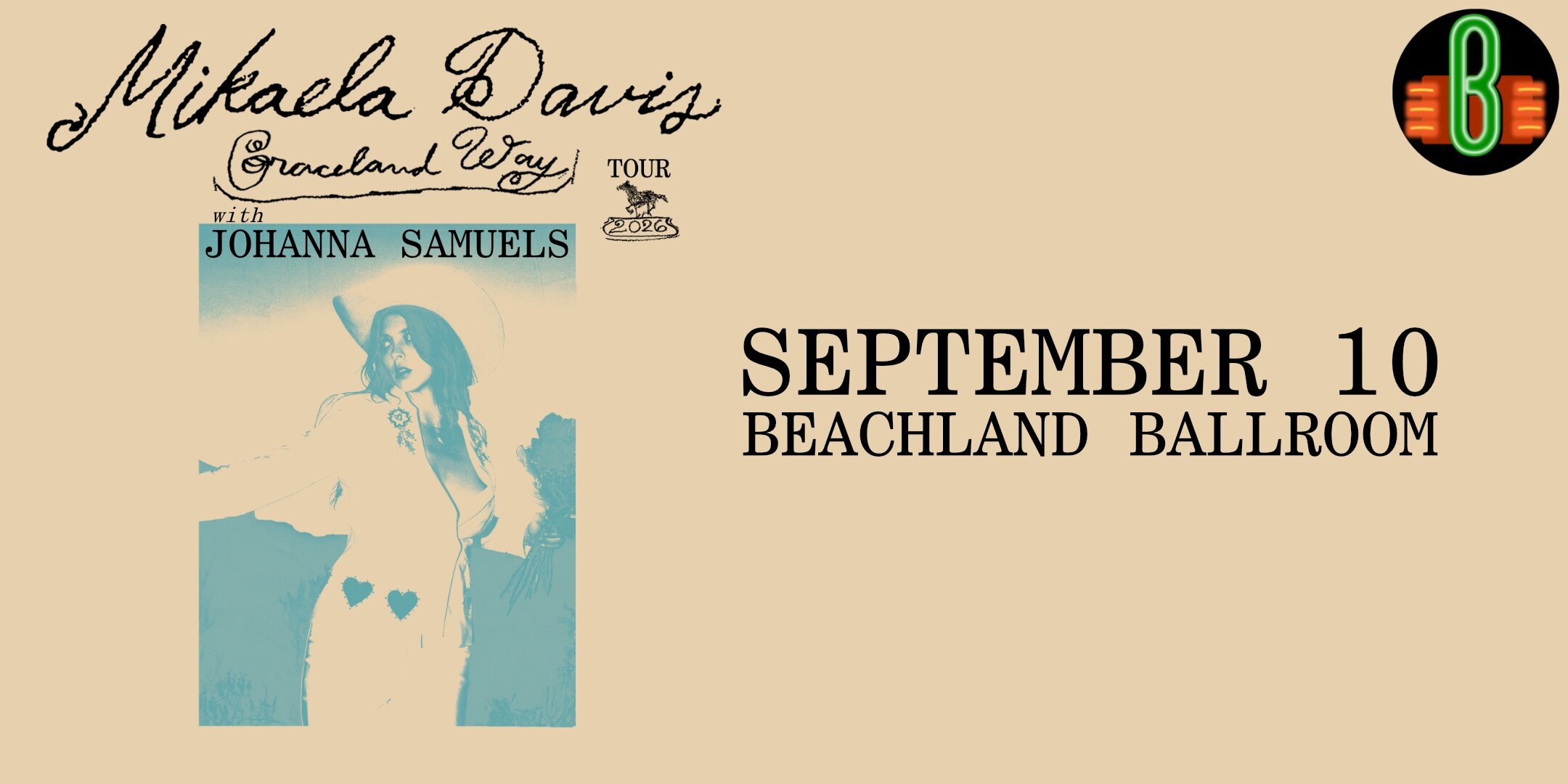
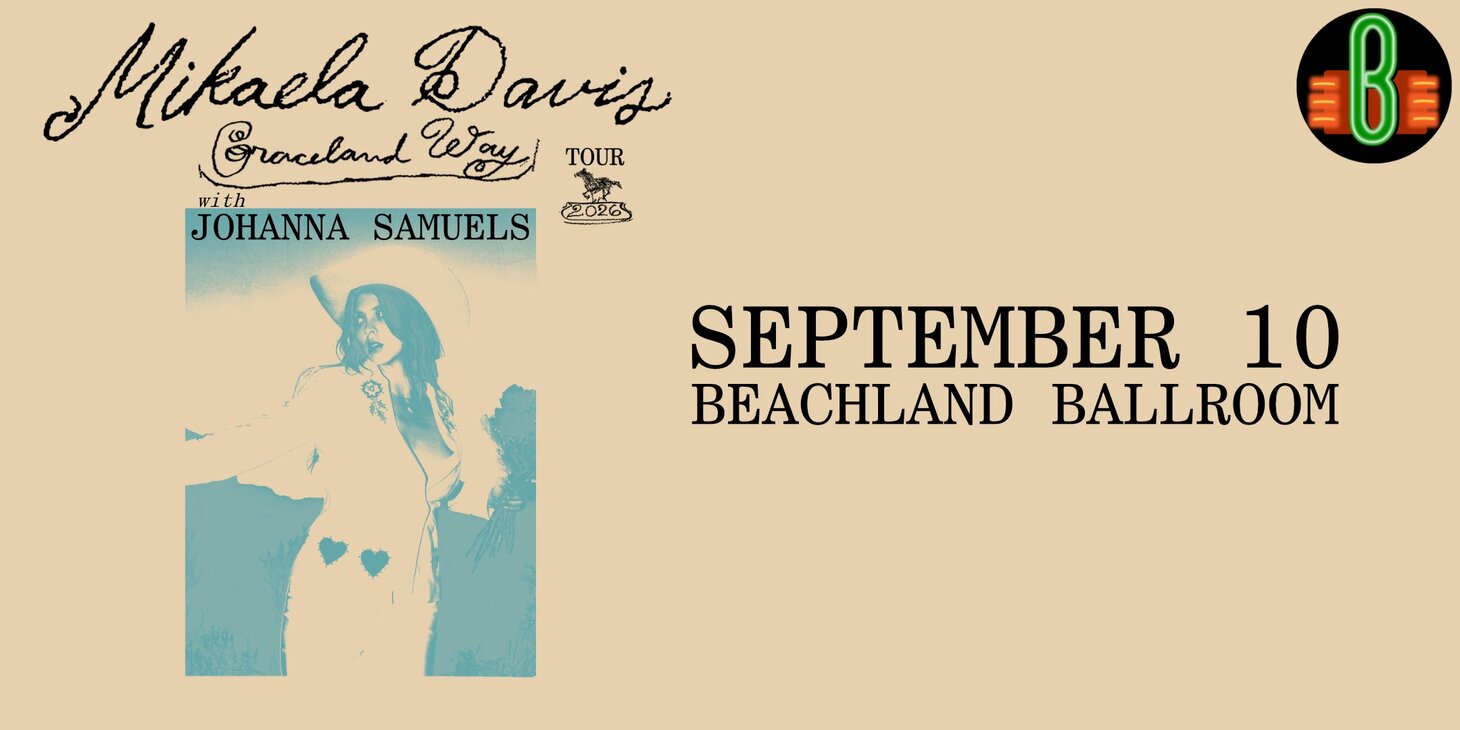
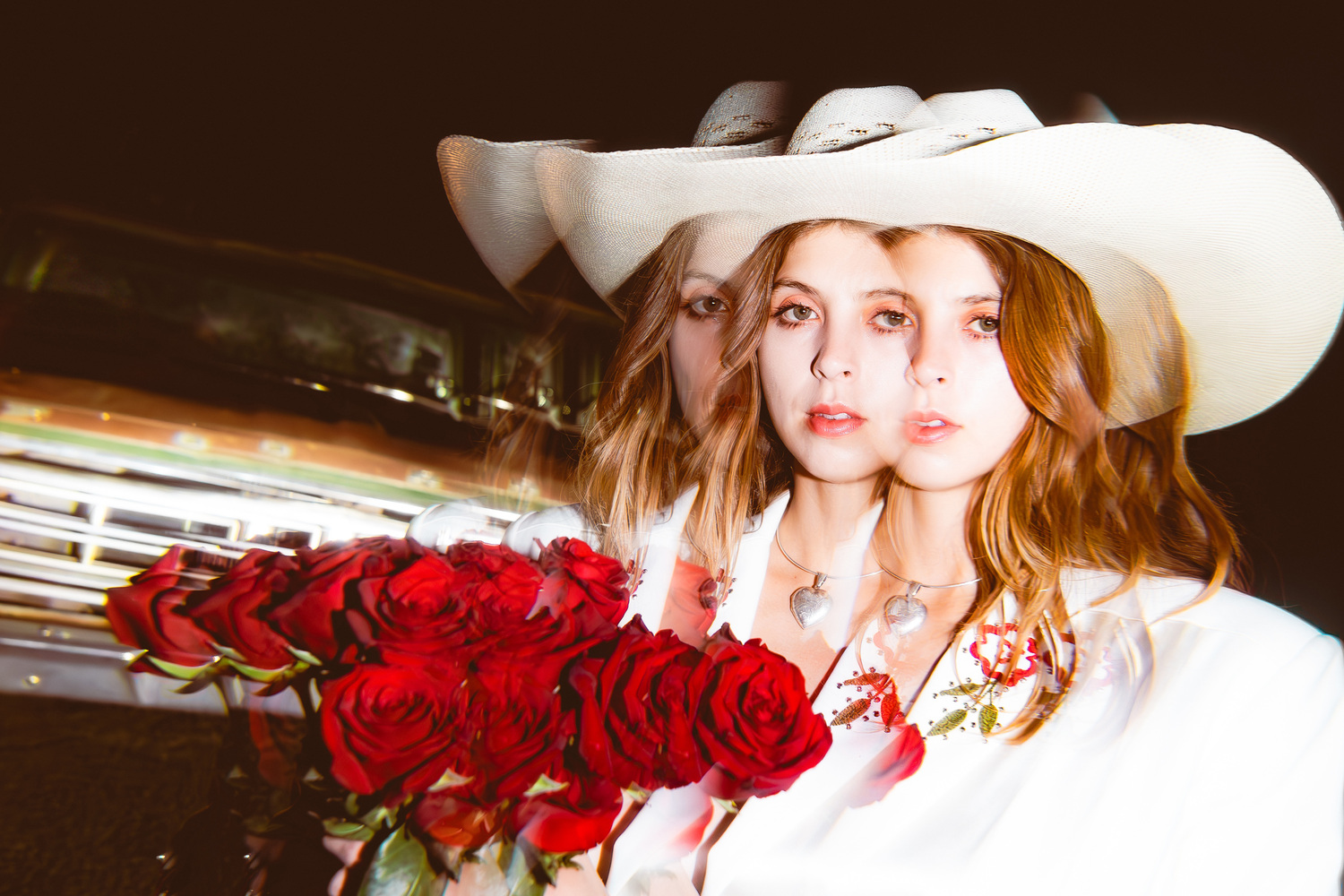
Every universe begins with a singular point, a quiet corner where instinct speaks loudest, where existential imagination can stretch its limbs. For acclaimed harpist and songwriter Mikaela Davis’ new album, Graceland Way (due April 24th via Kill Rock Stars), that singularity was a hillside home in Chevy Chase Canyon on the titular street, a spot nestled in Los Angeles County where time slowed, the world fell away, and Davis could create from a sense of warmth and passion. Graceland Way is the product of weeks spent watching dusk settle over the hills, encircled by the totemic presence of the studio’s pet black cat: the ever-watchful Bubu, a symbol of witchy good luck and quiet protection. The “canyon country” epic born of that work ties a neo-western future back to the lineage of Laurel Canyon, the mythos of Elvis’s Graceland, and Paul Simon’s restless reinvention. And across that grand sweep, Graceland Way explores the fragile humanity-defining balance of light and dark, grace and struggle, rose and thorn, as well as the mystical power found at their nexus.
The precise origin of Davis’ musical big bang comes in the form of Glendale’s UHF Studio, home of producer/bassist Dan Horne. Davis’ other trusted collaborator in the process was noted guitarist John Lee Shannon. The trio co-produced Graceland Way, a cozy braintrust that made the songs flow intuitively. “The studio was in Dan’s house, and we would just stay for a couple of weeks and work when the spirit moved us,” she explains. “It was a really fun way to work, and the best part was having Bubu there. He’s our best friend.”
Graceland Way also marks the debut of the Davis-Shannon songwriting partnership, the pair finding the album's message as her harp, his guitar, and their joint melodies unfurled. “The songs were written from our personal experience, but together they tell the arc of humanity,” she says. “The album tells the story of a character that any listener can identify with.” That’s immediately evident from the opening track “(Looking Through) Rose Colored Glasses”; after opening with a harp glissando burst reminiscent of being burst through a blissful wormhole, the track sets the listener out on a journey into the unknown after being jilted by a lover. “Throwing pennies in an empty fountain/ Rainbows in the dark/ Pulling petals from a dying flower/ A sudden change of heart,” she sings, the dark Western tones aided by Kurt G. Johnson’s pedal steel guitar and transformative harmonies from guest vocalists Madison Cunningham and Tim Heidecker. (“I love Madison. She's one of my favorite songwriters,” Davis says. “I feel like I found my Emmylou.”) But even in this pained origin story, Davis’ glittering, opalescent voice and evocative harp find a depth of beauty.
That duality is then immediately challenged in “Nothin’s On The Radio”, where the antihero arrives in a city devoid of meaning. “It already feels dystopic living in a world today where radio stations are all owned by a handful of corporations, all playing the same artists. Gone are the days when the radio was a way to bring people together, to amplify the voices of freaks and weirdos from all corners of the world,” she says. “I was fortunate to grow up in the last years of the golden age of FM radio, and being able to tune into this magical world far beyond my own was a transformative experience. Hearing artists like Sheryl Crow and Vanessa Carlton coming through the car stereo is what made me want to write songs and play music in the first place.” The resulting song, paradoxically, has all the smoky warmth of an alt radio hit, Neal Francis' organ and Shannon's swaggering guitar buttressing Davis’ crystalline calls: “Take me higher baby, like my favorite song/ Turn it up a little, ‘til the static is gone.”
The transportive power of music unifies the record—and Davis’ career at large. “The ability to shift our consciousness and remind us of our shared experience, how we are all connected, is what makes music so important,” she says. “My purpose in life is to create that magic and bring it to other people.” One of Davis’ first memories with that potential came when she first picked up a harp, inspired to play in honor of her then-recently-passed grandmother. “There’s something soothing and powerful about playing an instrument, especially when it’s twice the size of you,” she says.
As the album progresses and the story continues, Davis and her compatriots explore magic and mysticism on “11:11” and surrendering to the universe on “Wild Flower”. Darkness returns, as it tends to do, on the haunting “Mizmoon”, harp low end and rattling percussion giving way to slippery shadows of violin and more plinking harp. Written by Cass McCombs, the track draws inspiration from Patricia “Mizmoon” Soltysik, cofounder of the Symbionese Liberation Army. “When Cass first sent over the track, it was the coolest thing I'd ever heard,” Davis says. “The music and lyrics create such an ominous mood and I could imagine how the harp would carry the song right away.”
Whether surviving the dark night of the soul in a wasted robotic landscape on “Starlite Tonite” (“It’s a cautionary tale about corporate greed taking us past the point of no return”), using physicality as a replacement for meaning on “Junk Love” (featuring harmonies from Wednesday vocalist Karly Hartzman), or finding some sense of self through rejecting expectations on “(That’s Not) Who I Wanna Be”, Graceland Way not only works through balance in its lyrical themes, but in its expansive musicality. Davis’ harp masterfully powers the wide variety of soundscapes, taking on an ecstatic range of emotional color.
And across that kaleidoscopic journey, everything remains inextricably tied back to its origin. “At the end of the journey, the place you were destined for all along isn’t even a place, it’s a state of mind: Graceland Way,” Davis says. “It’s all interconnected and the universe balances itself. You need the dark to see the light, and the most beauty usually happens where the two meet.”
SHORT VERSION
Every universe begins with a singular point, a quiet corner where instinct speaks loudest, where existential imagination can stretch its limbs. For acclaimed harpist and songwriter Mikaela Davis’ new album, Graceland Way (due April 24th via Kill Rock Stars), that singularity was a hillside home in Chevy Chase Canyon, a spot nestled in Los Angeles County where time slowed, the world fell away, and Davis could create from a sense of warmth and deep attentiveness. The “canyon country” epic born of that care ties a neo-western future back to the lineage of Laurel Canyon, the mythos of Elvis’s Graceland, and Paul Simon’s restless reinvention—a place where Davis can explore the fragile balance of light and dark, grace and struggle, rose and thorn, as well as the mystical power found at their nexus.
The record’s musical big bang originated at the nexus of UHF Studio, where Davis and noted guitarist John Lee Shannon, co-wrote the record and co-produced alongside longtime collaborator Dan Horne. As the album’s story of an unnamed antihero navigating life in a failing world, her harp, his guitar, and their joint melodies weave a mystic depth. That’s immediately evident from the opening track “(Looking Through) Rose Colored Glasses”, a harp glissando burst functioning like a blissful wormhole to a new universe where dark Western tones come aided by Kurt G. Johnson’s pedal steel guitar and transformative harmonies from guest vocalists Madison Cunningham and Tim Heidecker. But even in this pained origin story, Davis’ glittering, opalescent voice and evocative harp find a depth of beauty.
That duality is then immediately challenged in “Nothin’s On The Radio”, where the antihero arrives in a city devoid of meaning, the dystopia of modern homogenized radio writ large. “It already feels dystopic living in a world today where radio stations are all owned by a handful of corporations, all playing the same artists. Gone are the days when the radio was a way to bring people together, to amplify the voices of freaks and weirdos from all corners of the world,” she says. “I was fortunate to grow up in the last years of the golden age of FM radio, and being able to tune into this magical world far beyond my own was a transformative experience. Hearing artists like Sheryl Crow and Vanessa Carlton coming through the car stereo is what made me want to write songs and play music in the first place.”
As the album progresses and the story continues, Davis and her compatriots explore magic and mysticism on “11:11” and the haunting darkness of “Mizmoon”. Cass McCombs wrote the latter, rattling percussion and Davis’ harp low end giving way to slippery shadows of violin. “When Cass first sent over the track, it was the coolest thing I'd ever heard,” Davis says. “The music and lyrics create such an ominous mood and I could imagine how the harp would carry the song right away.” Elsewhere, Wednesday vocalist Karly Hartzman contributes to “Junk Love”, an exploration of knowingly filling an empty space with meaningless physicality. Across Graceland Way, Davis’ harp masterfully powers the wide variety of soundscapes, taking on an ecstatic range of emotional color. “At the end of the journey, the place you were destined for all along isn’t even a place, it’s a state of mind: Graceland Way,” Davis says. “It’s all interconnected and the universe balances itself. You need the dark to see the light, and the most beauty usually happens where the two meet.”
Website • Instagram • Facebook • Spotify • Apple Music • Tidal • Youtube
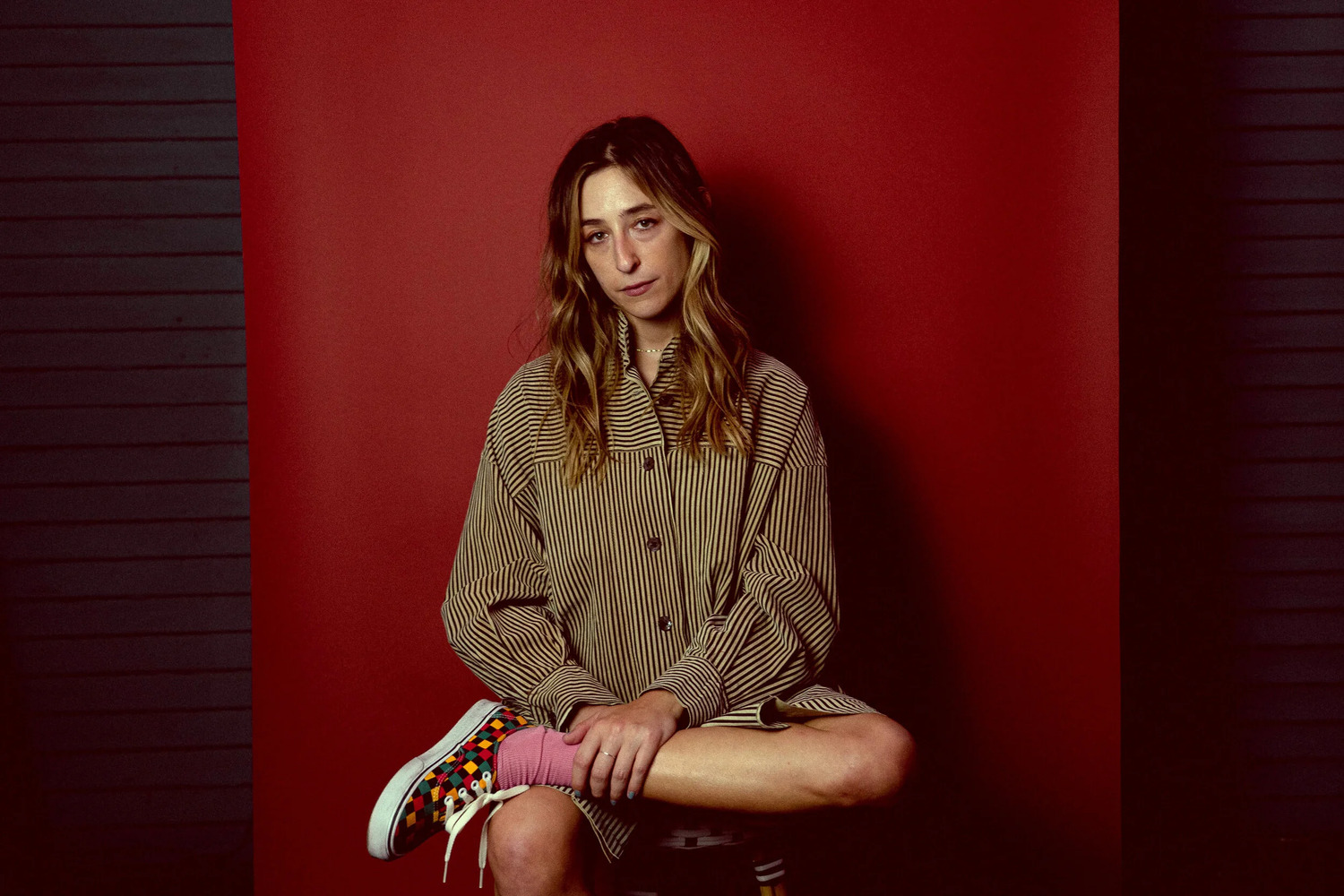
“Before making this record, I was feeling the furthest from myself that I ever had.” Reflecting on her forthcoming album Excelsior!, Johanna Samuels continues, “There was a lot of cognitive dissonance—wanting to pursue my music while also being able to feel good about who I am as a person. This record is a lot of me identifying what I don’t want to be.”
A wholly personal document, Excelsior! finds the LA-via-NYC songwriter exploring the nuances of her interpersonal relationships and the importance of listening to each other, understanding that a conversation doesn’t have to end because one person has to be right and the other wrong.
The album was recorded deep in winter, snowed-in at producer Sam Evian’s upstate New York cabin, soon to be called Flying Cloud. Recorded mostly live to tape with Samuels’ band ~ Harrison Whitford (guitars), Garret Lang (bass), and Sean Mullins (drums) ~ it was Evian's first full-length production at his new cabin studio. Excelsior! is as gently elegant as we’ve come to expect from Evian’s own records, but it’s driven by Samuels’ easy yet arresting melodicism and confidently vulnerable delivery.
Just as the songs on Excelsior! seek answers through companionship, Samuels calls upon a handful of womxn to provide the album’s backing vocals—a task she’d always performed herself until now. “I made the record mostly with men, and that's a space I find myself in constantly in music,” Samuels says, “so it was a very important and special part of the record to have these different womxn that held me up. I really looked up to all the womxn that sang on the record.” As such, Excelsior! makes space for the voices of Courtney Marie Andrews, Hannah Cohen, A.O. Gerber, Olivia Kaplan, Maví Lou, and Lomelda’s Hannah Read.
This is what pulls the songs together most—Samuels’ desire to re-establish bonds of community and connection—something she believes we’ve all lost in recent years. Indeed, much of Excelsior! finds her learning how to navigate being supportive of other womxn when for so long they’ve been pitched against one another. “How much space is given to us is so often dictated by men and it pits us against each other and has become ingrained in who we are. I’ve definitely acted against myself because of that, and in ways that I didn't feel like were authentic to myself,” Samuels explains.
That kind of communication breakdown is mirrored everywhere right now, resulting in rejection, anger, a loss of connection. Across its ten songs, Excelsior! documents the many ways that these allegiances can fall apart. “I want to be alone / More than I want to be alone with you,” she sings on the beautifully withdrawn opening track “Sonny”; while “Nature’s Way”, a defiantly more upbeat track, explores how easy it is to take empathetic nature for granted and how the loudest person is so often the most celebrated: “I've got a funny thing about saying what I want aloud / You push it so far down below / It’s here with its hands around my throat.”
Lead single “High Tide for One” is a slow-groove dance between spaced-out slide guitar and Samuels’ lilting Rhodes, written in response to the public plight of Dr. Blasey Ford. “My heart was broken for her and I reflected on how much scarcity of space and validation in basic experience there is for all female-identifying people, even in my own privileged, liberal community,” says Samuels. “It felt a bit hopeless. I felt exhausted, and for a while, I didn't have the strength to explain it or try to talk it through with anyone who wasn’t working to change it.”
Elsewhere, “All Is Fine” unravels like Figure 8 era Elliott Smith, with the punchy drums and Samuels’ engrossing voice shifting the tone of the record into something bolder and more defiant: “Sometimes I even keep what's mine / So take your time, I'm already gone.”
Out now on Mama Bird Recording Co. (US/World) and Basin Rock (UK/EU), Excelsior! takes its name from the signature that Samuels’ grandpa would use before he sadly passed away last December. “He was a very important person to me and he helped raise me,” Johanna explains. “He signed all of his letters and emails ‘Excelsior!’, including the exclamation point. It means ‘ever upward’ and that’s what I wish for everyone: to grow from listening with more empathy and from hearing each other out. I hope this record makes people want to be gentler with each other and themselves.”
Website • Instagram • Facebook • Apple Music • Spotify